
As members of the Texas Education Agency’s Data Governance Committee, representatives from Texas A&M University–Texarkana volunteered for a small pilot program offered by the Insight to Impact Dashboards Team to test the Observation Tool.
Texarkana Instructor of Education Dr. Debora Shidemantle and Certification Coordinator Amy Miller have been seeking to fill a major gap in the program’s continuous improvement efforts: consolidating observation data from multiple systems.
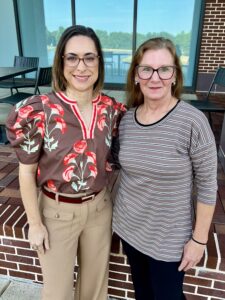
Miller and Shidemantle
Although the team has had limited interaction with the tool, its members are encouraged by their initial impressions.
“We were looking for a system that would allow us to set those tight targets,” Miller said. “What we see in clinical practice is directly correlated to what happens in our students’ education classes, but we were struggling to find a way to easily correlate what they learn in class with their practicum experience in the field. We’re hoping this tool will give us that bridge.”
Participating in the pilot allowed the pair to anticipate what was coming and become familiar with the tool for future use. Their efforts also helped TEA discover and correct an issue with how the tool read admission records.
Because the time commitment was minimal, the Texarkana team believed participating gave them the best “bang for their buck.” TEA actively requested and accepted their input while building the system and tool.
“We love the visualizations, but we also value the ability to dig deeper than simply meeting minimum requirements,” Miller said. “We want to dig deeper for continuous improvement by examining the ratings for each domain and competency within the observations and tracking them for both our students and the program as a whole.”
Dr. Shidemantle tied the tool’s value back to continuous improvement and coursework.
“This will allow us to set the targets we’ve been seeking in our courses and determine where our students are landing on the T-TESS rubric,” she added. “It’s going to be a very helpful tool, not only for continuous improvement, but also because pulling observation data quickly from one source helps us with governance.”
The data allows the team to identify students’ strengths and areas for improvement, track domains and dimensions in the T-TESS rubric, and recognize proficiency in specific areas across different observations.
Overall, the Texarkana EPP appreciates that TEA is introducing a system that delves more profoundly into observation data than was previously possible while connecting and communicating with other systems. As an added benefit, the tool sends data to ECOS, effectively reducing the workload for EPPs and allowing them to spend more time analyzing data rather than corralling it.